Projects
Projects
A selection of the most recent projects showcasing full-stack engineering, AI integration, and complex system design.
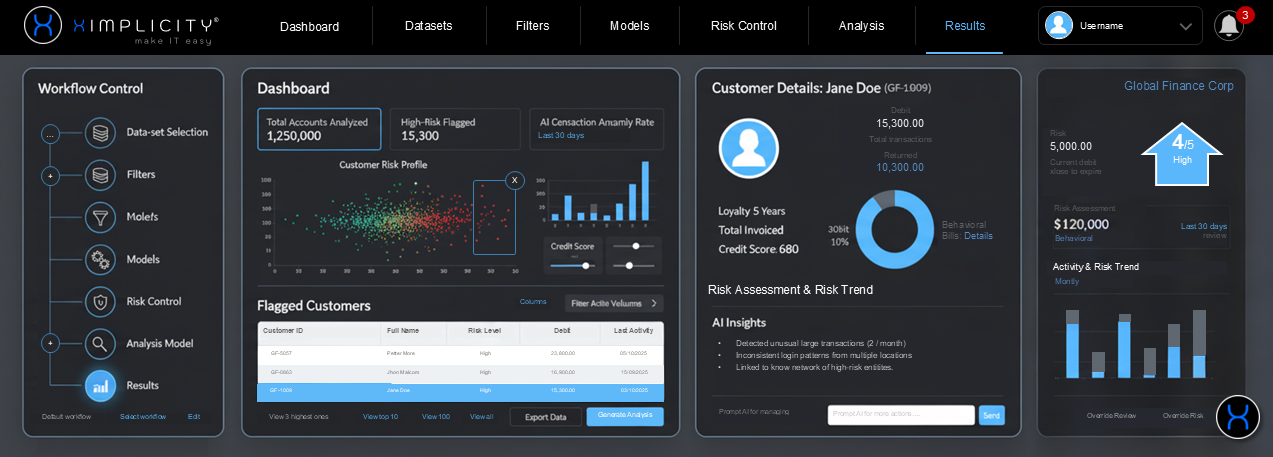
Key Features
- Advanced filters based on values and categories
- AI-driven models for data categorization
- Machine learning for risk assessment & alerting systems
Results
- 75% reduction in risk assessment processing time
- 40% decrease in false positives
AI-Driven Risk Assessment & Analytics SPA
Challenge
A major financial institution was struggling with manual risk assessment processes that were time-consuming and prone to human error. The client was also looking for quick adaptation to market trends and regulations, and cost optimization.
Solution
Ximplicity implemented an AI-powered risk assessment system that integrated with their existing infrastructure, automating the analysis of customer data and transaction patterns, supporting multiple workflows and model integrations.
Technical Contribution
I designed the data flow architecture to decouple AI inference workloads from the main application, using RabbitMQ for async orchestration between FastAPI model services and the NestJS backend. I built the Angular SPA with dynamic filter pipelines and real-time alerting dashboards, and integrated Keycloak for role-based access across institutional teams. The system was containerized with Docker and deployed on an internal cloud environment with horizontal scaling for inference workers.
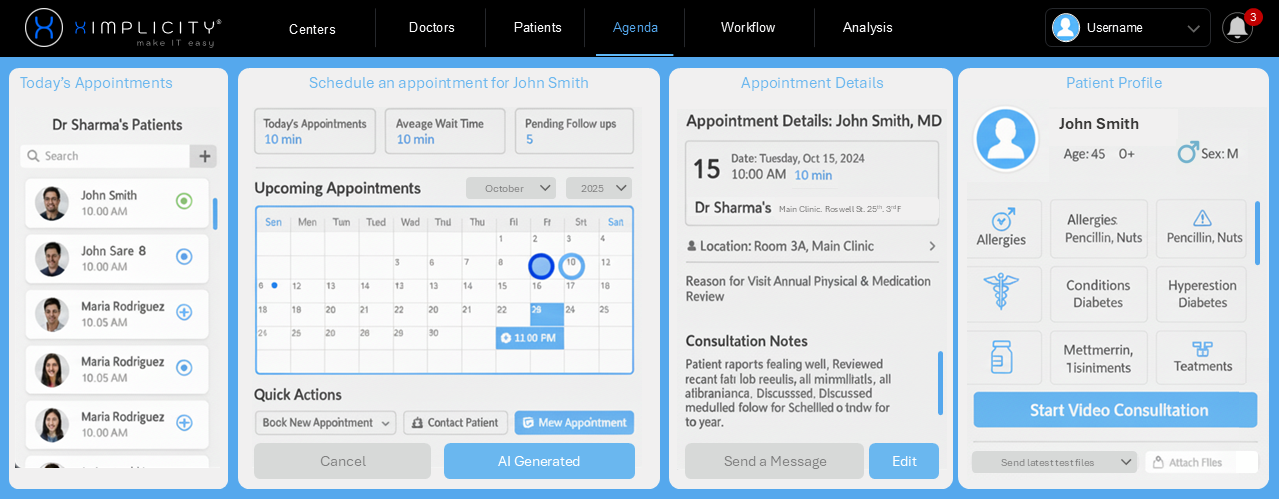
Key Features
- Enhanced patient experience
- AI-driven models for schedule optimization
- Automatic rescheduling and non-intrusive messaging
Results
- 40% reduction in patient wait times
- 25% increase in patient throughput
Streamlining Patient Care Workflows
Challenge
A healthcare provider was facing inefficiencies in their patient care workflows, leading to longer wait times and reduced quality of care.
Solution
Ximplicity provided CTO-as-a-Service to analyze their existing systems and implemented a workflow optimization solution that streamlined patient appointments, intakes, diagnosis, and treatment processes without disrupting their systems.
Technical Contribution
I restructured legacy synchronous workflows into an event-driven orchestration model using NestJS and Redis pub/sub, enabling real-time rescheduling without downtime. I designed the React frontend with an agenda-centric UX, integrated TensorFlow-based optimization models via FastAPI, and implemented WhatsApp-style non-intrusive messaging for patient communication. The platform runs on AWS with MongoDB and is secured through Keycloak multi-tenant authentication.
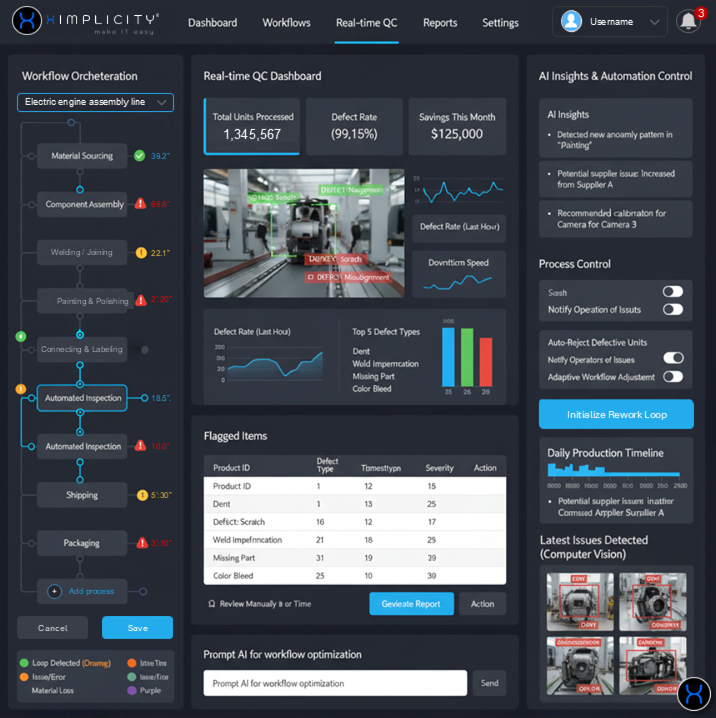
Key Features
- MQTT workflow implementation connected to sensors
- Computer vision integration and machine learning
- Real-time data exchange and business intelligence
Results
- 85% reduction in defect rates
- 60% decrease in quality control costs
AI-Powered Quality Control for Manufacturing
Challenge
A manufacturing company was experiencing high defect rates and quality control issues that were impacting their reputation and bottom line.
Solution
Ximplicity designed and implemented an AI-powered quality control system that uses computer vision to detect defects in real time during manufacturing, and integrates MQTT-based workflow orchestration into a professional, responsive web application.
Technical Contribution
I designed a low-latency ingestion pipeline that processes sensor and vision data streams via MQTT into a PostgreSQL time-series store, feeding YOLOv12 and Qwen2.5-VL models for defect classification. I built the Angular frontend with live production dashboards, integrated n8n for no-code workflow automation, and exposed an MCP interface for AI-driven process queries. The entire stack was containerized with Docker and orchestrated for edge deployment in factory environments.
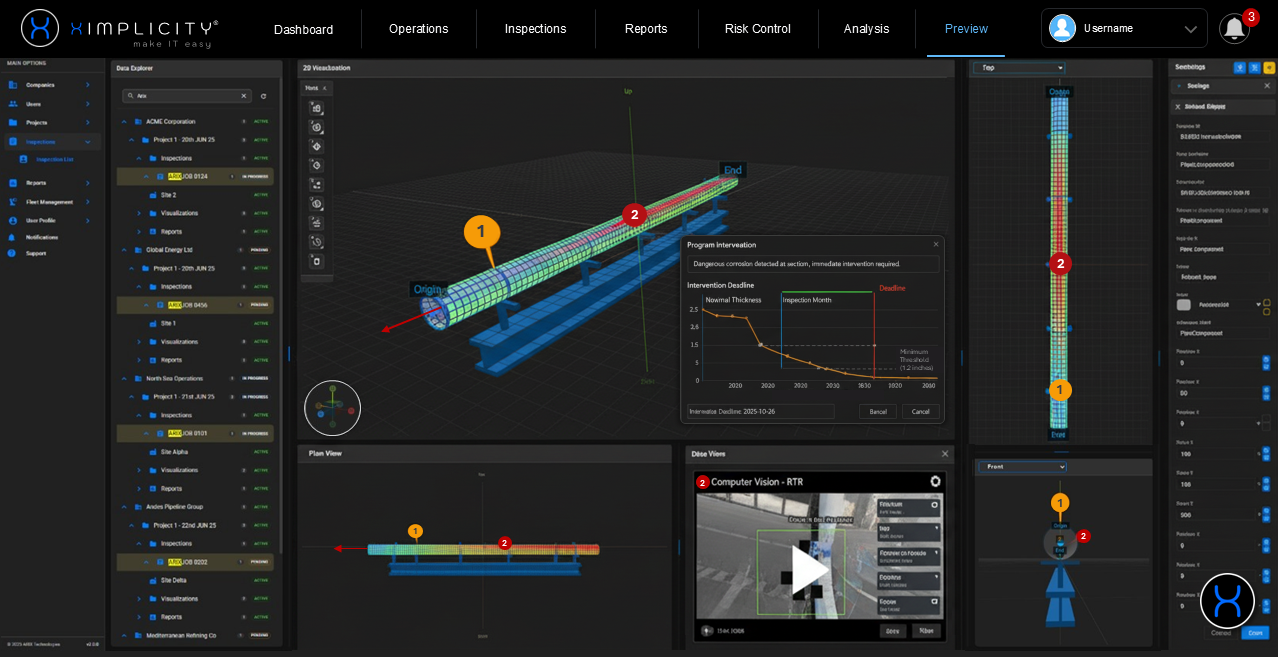
Key Features
- Fully integrated digital operation monitoring
- Corrosion models & computer vision analytics
- Symbolic and 3D digital twin inspections
Results
- 90% faster report generation
- Significant cost savings per inspection cycle
NDT Inspections on Refinery Pipelines
Challenge
A robotic NDT inspection provider required a comprehensive inspection portal to visualize different NDT data sources on digital twins of inspected pipeline components, and to create automatic annotations and reports based on analytics and computer vision models.
Solution
Ximplicity provided CTO-as-a-Service to structure their business domain, define the data model, and build a web-based solution to manage all data collected by the robot, providing symbolic and digital twin 3D inspection of components.
Technical Contribution
I designed the platform data model to handle heterogeneous inspection sources — RTR (Real-Time Radiography), Pulsed Eddy Current (PEC), and visual — unified under a single schema. I built the Angular + Three.js frontend for 3D digital twin visualization with annotation overlays, developed the SignalR real-time sync layer for collaborative review sessions, and implemented corrosion prediction models in Python. The backend runs on .NET with RabbitMQ for async processing, PostgreSQL and Redis for persistence and caching, and Keycloak for multi-org access control (I authored the data model, technical specification, and integration layer, and developed several core services; other services were built by the extended team).
Beyond implementation as Senior Full-Stack Engineer, I also served as Scrum Master, UX Designer, and Solution Architect on this project. The platform continues to grow in production, and I remain actively involved in its evolution from Ximplicity. That work means new high-value services, better quality and efficiency in how results are produced and presented, and stronger business processes. It also means bringing in advanced techniques for data inference, computer vision and visual representation — the capabilities my client’s own inspection, analytics and reporting service is built on.
Key Features
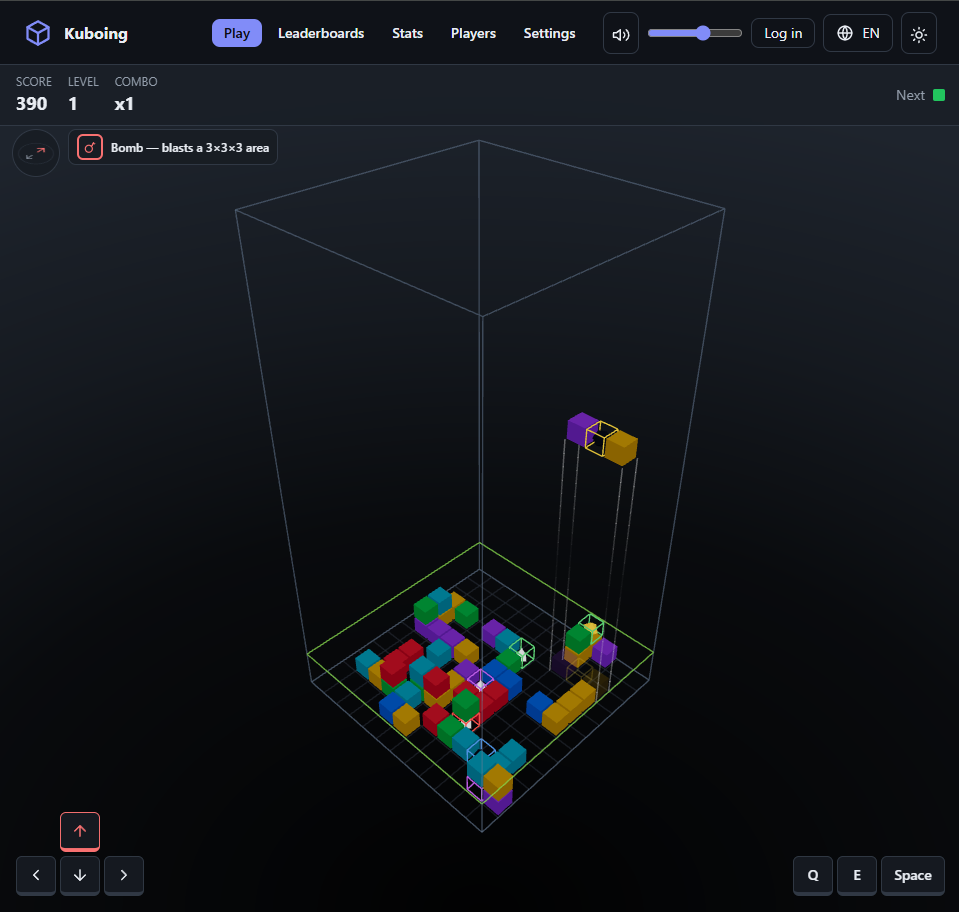
- 12×12×24 Z-Up board with burst-and-cascade scoring
- One input model: keyboard, mouse, gamepad and touch
- Interchangeable mock and production facades behind one configuration flag
Results
- Playable online, free and with no sign-up
- Over 80% branch coverage, zero-defect quality gate
Kuboing — 3D Cube Cascade Puzzle
Challenge
Real-time 3D in the browser and a production-grade client–server product are usually demonstrated separately, and rarely by the same engineer. I wanted a single artefact that proves both at once — and that stays honest about its scope, because the hardest part of a solo project is actually finishing it.
Solution
Kuboing is a casual-competitive 3D puzzle: pieces fall onto a 12×12×24 Z-Up board, the player fits them, connects colours, triggers bursts and rides the cascade. React and Three.js power the client, while NestJS and PostgreSQL power the API, and in the integration layer I used the facade pattern, which ships a mock implementation alongside the real one — which is what lets the online demo run with no database behind it. As a further demonstration, game state is managed reactively through a local state-management pattern, and the production build adds a security layer: authentication and identity with Keycloak, persistence in PostgreSQL, and an abstraction layer over TypeORM. Building with Vite completes the demonstration of a cross-platform solution.
Free and with no sign-up — give it a few minutes right here in your browser.
Technical Contribution
This one is mine end to end — the idea, the game design, the art direction, the UX, the client, the server and the deployment. It began as a gamebook rather than as code: identity, elevator pitch, target platforms, and the whole mechanic of drop, fit, connect, burst and cascade, down to the scoring that makes a combo feel earned. A casual game lives or dies on whether its first sixty seconds are legible, and that is a design problem long before it is an engineering one.
The client is React and TypeScript with Three.js through React Three Fiber, game state managed with Zustand, and a render loop kept free of per-frame allocation so a mid-range phone holds its frame rate. The board is 12×12×24 in a Z-Up world, which is what makes the spatial reading honest and the camera work hard. The multi-device UX is a single input model expressed four ways — keyboard, mouse, gamepad and touch gestures — over a layout where the 3D board and the essential HUD are always the protagonists and everything else lives in drawers and overlays. The API is NestJS with TypeORM and PostgreSQL, authenticated through Keycloak, documented with OpenAPI, and built on a generic paging, filtering and ordering contract the front-end tables bind to directly. Every integration boundary exposes an abstract facade with two interchangeable implementations, mock and real, selected by a single environment flag.
The constraint I set myself was that all of it had to stay within reach of one developer: small single-responsibility units, JSDoc on every public surface, i18n from the first screen instead of retrofitted, design tokens so the entire look changes from one file, and branch coverage above 80% enforced by the build rather than by good intentions. That is the real point of the project. Not that a browser can render cubes — that one person can carry a product from an idea to a deployed, tested and documented client–server system without cutting the corners that are what make it a product.
I am a designer and full-stack developer. I started writing video games as a child in the eighties, on Z80 microprocessors. Several decades later I still enjoy that same passion and, whenever my work as a senior developer on professional products leaves me the time, I build a game purely for the fun of it. This is one of them. I hope you enjoy it.
Let's Build Something Great
Have a project in mind? I'd love to hear about it and explore how I can help.